
- Monday 25 May 2026
- 0 Comments
What is Explicit Teaching? Exploring Key Strategies and Resources
Educators around the world are all talking about explicit teaching!
As one of the most proven, popular, and evidence-backed teaching strategies, explicit teaching occurs in classrooms every single day. Research suggests that explicit teaching methods promote higher student achievement regardless of ability levels or learning styles. But in the modern era, where inquiry and student-led learning have been encouraged among educators, many believe that there is no longer a place for explicit instruction.
Let’s guide you through understanding what explicit teaching is, how to implement it in your classroom, why it’s so important, and what resources you need to get started!
What is explicit teaching?
Explicit instruction is rooted in success. It is a systemic, high-impact teaching strategy that is intrinsically teacher-centred, focusing on guiding and scaffolding students through effective frameworks that support their understanding of new concepts and content.
Many educators and parents often confuse explicit teaching with direct instruction. Direct instruction is a highly scripted approach that focuses largely on repetition and call-and-response techniques to develop understanding. While explicit teaching is similarly scaffolded and supported by an educator, it has been developed to allow for more flexibility, questioning, and inquiry than the direct instructional model.
Similarly, implicit teaching methods have grown in popularity in recent years, prompting educators to question the value of explicit teaching. In implicit teaching, students are encouraged to learn organically when they are provided with relevant content and information, rather than having clear, defined learning goals. Elements of implicit teaching can be seen in inquiry-based learning programs and other student-centred methods.
Research shows that explicit teaching methods consistently produce stronger results across all student bodies. In Explicit Instruction: Effective and Efficient Teaching (Archer and Hughes 2010), explicit teaching is described as a crucial tool for ‘when discovery may be inaccurate, inadequate, incomplete, or inefficient’.
Is there a place for implicit teaching methods? Absolutely! However, research tells us that its place is within an explicit teaching framework that leads students towards successful learning pathways.
What is the explicit teaching framework?
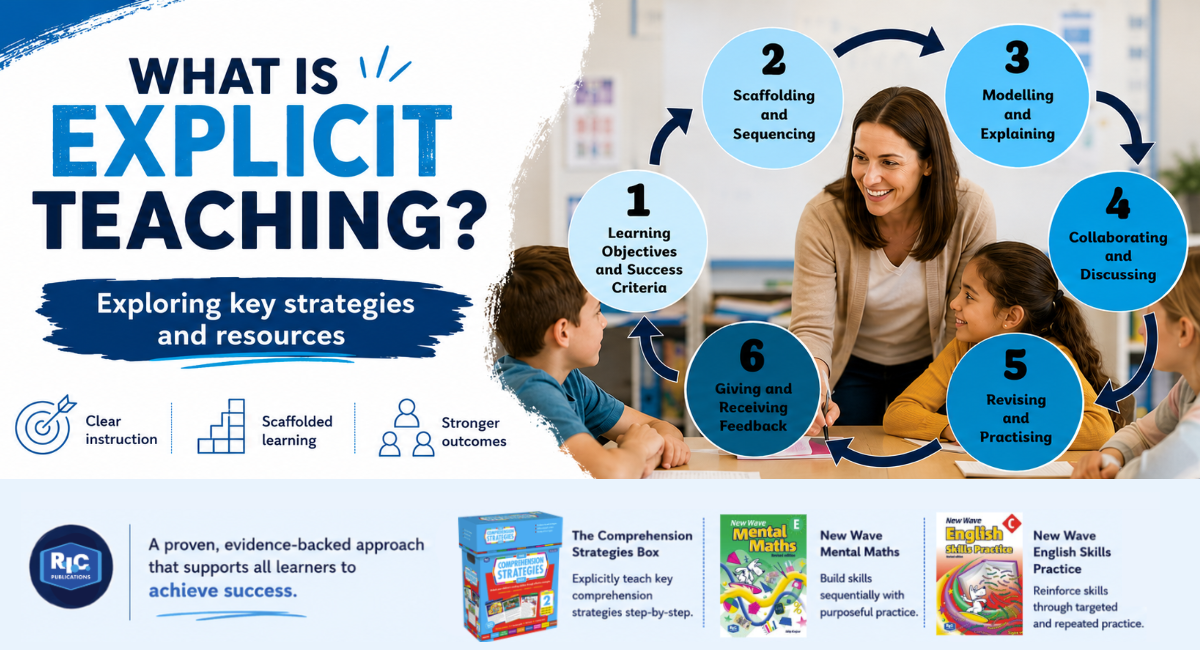
The explicit teaching framework is a fundamental starting point when planning an explicit teaching lesson or unit. By following the framework's guidelines, you and your students will be poised for success! Are you ready to get started?
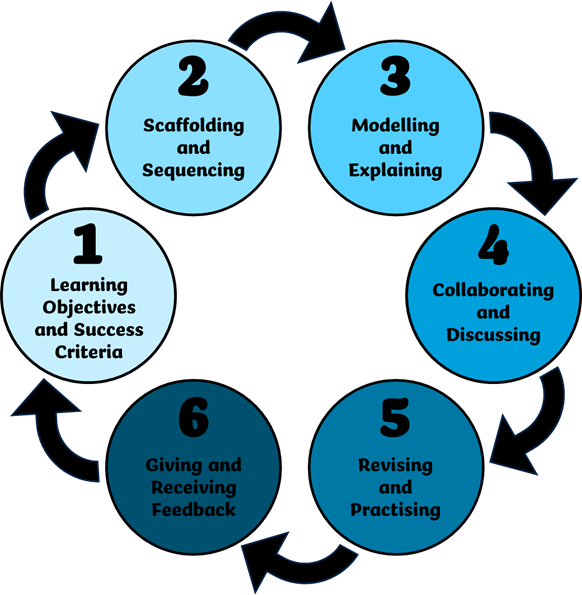
1. What is the learning objective?
The first step in explicit teaching is clearly outlining what students will learn and how they will know they have succeeded. This is commonly referred to as learning objectives and success criteria.
Educators should discuss these two elements with students at the beginning of each lesson, so students understand what they are about to do and what is expected of them (AERO 2024). You might like to verbalise these two elements, write them somewhere easily visible (e.g. on a whiteboard or on sticky notes on student desks), and use structured language (e.g. ‘We are learning to …’ and ‘I can …’) to establish clear learning patterns. For younger learners, try using sequenced image cards!
Here at R.I.C., our Australian Curriculum series often provides clear examples of learning objectives and success criteria that you can easily utilise in your classroom. For example, our Australian Curriculum Health series provides assessment questions aligned with each lesson plan, which you can use to demonstrate expectations to students at both the introduction and conclusion of a lesson.
2. How is information scaffolded?
Students learn best when information is broken down into manageable chunks. Educators can scaffold the delivery of this information by organising it along logical learning pathways. This method supports students’ brain development, reducing the demand on their working memory and allowing them to fully comprehend new information piece by piece.
3. How can modelling support explanations?
The gradual release of responsibility model suggests that learning is most effective when it follows three basic steps: I do, we do, you do.
In the ‘I do’ stage of learning, educators use modelling to clearly explain a concept and demonstrate how the success criteria can be achieved. By completing this step for each new scaffolded piece of information, students will better understand expectations and processes before attempting to demonstrate independently.
We love using our Comprehension Strategies Box resource with this model in the English classroom! It contains a comprehensive step-by-step guide for educators to follow that utilises the gradual release of responsibility model to effectively and explicitly teach different comprehension strategies.
4. How do students describe their thought processes?
In the ‘we do’ stage of learning, students collaborate with the educator to demonstrate understanding. This step focuses on self-talk, asking students to verbalise their thoughts to establish clear steps in their processes and identify any misconceptions or gaps in their learning.
You can achieve this by working through problems as a whole class, facilitating small group discussions, or debating the effectiveness of modelled processes. The weekly Problem-Solving tasks in our New Wave Mental Maths series are ideal for whole-class sharing!
5. How will students practice their new skills?
Now that students have demonstrated a strong understanding of the new concepts presented, it’s time to practise! Use the ‘you do’ step of the model to provide opportunities for repeated independent revision.
One of our favourite resources for this step is our New Wave English Skills Practice series, which focuses heavily on skill repetition to ensure strong student understanding.
6. How will students give and receive feedback?
Timely, clear feedback is an essential part of the explicit teaching framework. It allows students to reflect on their learning objectives, assess whether their work meets the success criteria, and identify potential areas for improvement or extension.
Feedback should be offered by educators, peers, and the students themselves, enabling consistent, deliberate reflection on learning. Feedback can be given at all steps of the explicit teaching framework, and can be applied to formal assessment tasks, as seen in our Australian Curriculum Primary Maths Assessment series.
Common misconceptions
Explicit teaching often receives a poor reputation in the classroom due to common misconceptions about the methodology and delivery. Let’s explore some examples of those ideas and how explicit teaching goes against them!
It’s too scripted!
This misconception often results from confusing explicit teaching frameworks with direct instruction. Explicit teaching does not use a script, so educators can adapt their lessons on the fly to better suit their students.
It doesn’t allow for creative or critical thinking!
The structure of explicit teaching allows educators to implement a variety of opportunities for creative and critical thinking! Educators can use manipulatives or kinaesthetic learning experiences, use inquiry questions to guide learning objectives, and use feedback to identify opportunities for extension.
It’s boring!
Structure doesn’t have to be boring! The explicit teaching framework can be implemented across a wide range of learning experiences, such as games, small-group rotations, and STEM projects.
Our STEM Projects Box resource incorporates the essential areas of learner diversity and assessment, including glossary cards that can be used for word walls, explicit teaching, or playing games.
It removes teacher autonomy!
Educators are overwhelmed by daily administrative pressure. Explicit teaching frameworks allow you to easily curate a learning experience that best suits your class with little prep work required.
Want some help to get started? We recommend our Comprehension Strategies Box as the ideal starting point for understanding and implementing explicit teaching practices in your English lessons – with minimal prep required.
I’m ready – let’s get started!
Does explicit teaching sound right for you? Remember: Focus on crafting sequential, scaffolded learning experiences that follow the explicit teaching framework.
If you want to make your planning even easier, check out our resource range for a huge variety of supporting products that will simplify your preparation using evidence-based, curriculum-aligned lessons.
Want to learn more? Check out our recent blog, The Science Behind Explicit Teaching, to learn more about how this method employs cognitive load theory to effectively train student brains!