
- Thursday 28 May 2026
- 0 Comments
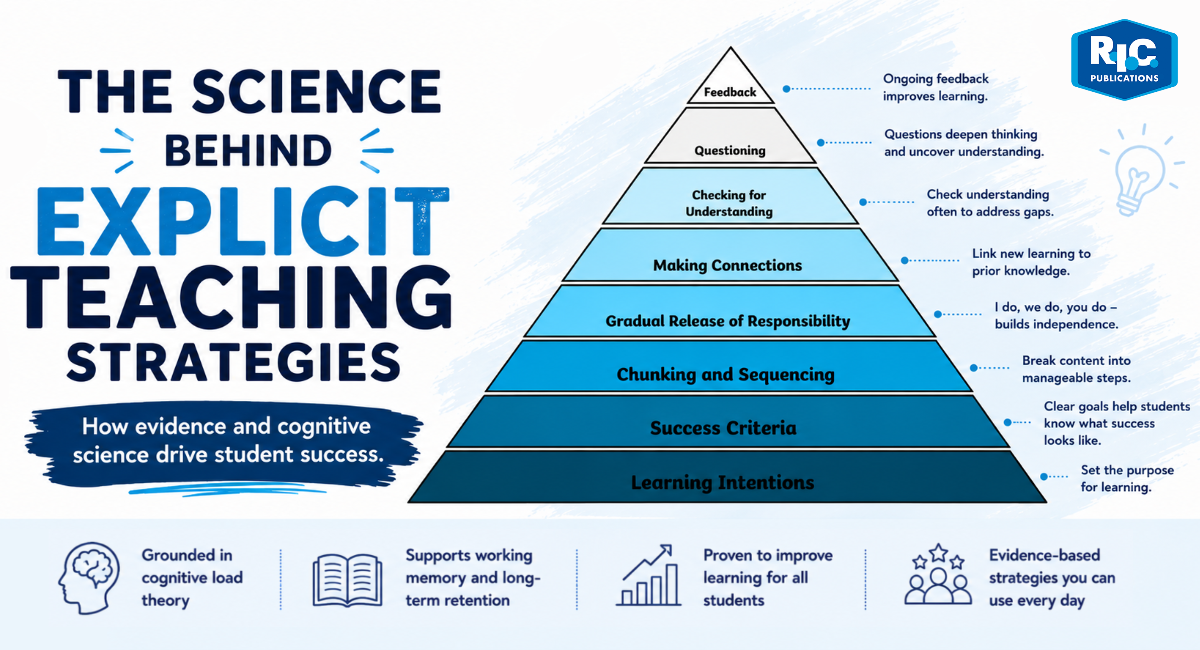
The Science Behind Explicit Teaching Strategies
It’s no secret that there are so many different teaching strategies and ideas out there that it can be hard to know where to begin!
While modern pedagogical approaches have championed student-led models like inquiry-based learning, recent developments in educational research have led government bodies and scientists to push for greater use of explicit teaching strategies in our classrooms.
So, what does explicit teaching look like, and why is it important?
What is explicit teaching?
Explicit teaching is a framework of teaching and learning that is teacher-centred, direct, sequential, and success-oriented. It relies on educators using clear directions, instructions, and success criteria in a scaffolded series of learning experiences, allowing students to efficiently learn, store, and retain new knowledge.
Proponents of explicit teaching, like the NSW Education Department, recognise its value as a proven method of delivering content to all students, regardless of ability level or learning style.
Critics argue that explicit instruction is too scripted or dull for students to engage with. However, when utilised correctly, explicit teaching can allow educators and students to contribute substantially to the content and its delivery, ensuring that lessons remain engaging and exciting. Unlike direct instruction, explicit teaching does not rely on a call-and-response script. Instead, it adapts to students’ inquiry, prior knowledge, and learning goals.
What is cognitive load theory?
Explicit teaching is based on cognitive load theory, which explores how the brain learns, stores, and retains knowledge.
Cognitive load theory suggests that our working memory can process only a limited amount of new information at a time, whereas our long-term memory has no known limit to the amount of information it can store. This means that information is best retained when it is segmented into smaller, sequential chunks, allowing the brain to process it through our working memory and store it before needing to work with new ideas.
The explicit teaching framework is designed to support this process by helping students transfer chunks of new knowledge from working memory to long-term memory. According to the Australian Education Research Organisation, using explicit teaching strategies addresses the limitations of students’ working memory by delivering content sequentially and gradually, then using revision and feedback to consolidate the information in long-term memory. Once stored in long-term memory, this information is retained and retrieved as necessary to support future learning.
What does the research say?
Authors such as Anita L. Archer and Charles A. Hughes have delved deep into the benefits of explicit instruction, including both academic success and educator confidence. Their research demonstrates the proven effectiveness of explicit teaching strategies in a wide variety of classroom scenarios.
Additionally, studies documented by Andrew J. Martin and Paul Evans have also consistently shown that explicit teaching methods support the reduction of cognitive load and students’ development towards productive independent learning.
The explicit teaching framework
The explicit teaching framework consists of six key steps that are repeated each time a new concept is introduced. For a more detailed guide to the explicit teaching framework, check out our recent blog, What is Explicit Teaching? Exploring Key Strategies and Resources.
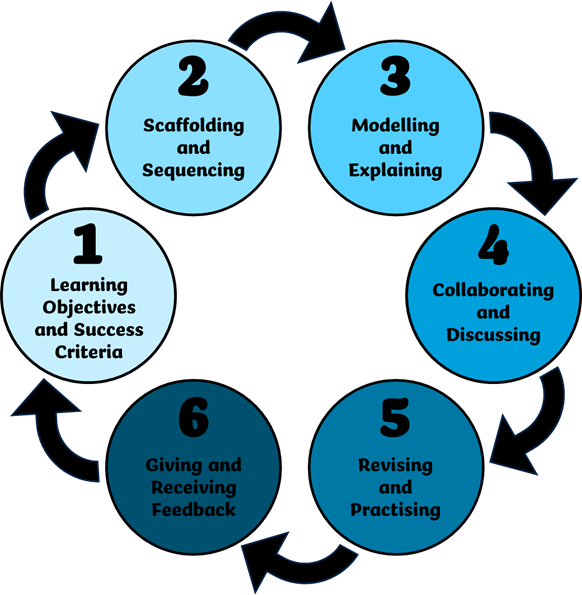
How do I implement explicit teaching strategies?
The explicit teaching framework employs several key strategies to ensure educator and student success. Understanding these is essential for crafting an ideal learning sequence!
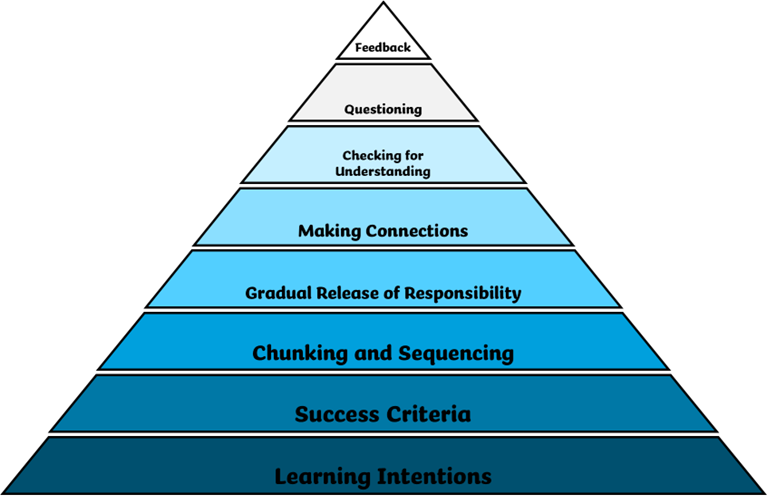
1. Learning intentions
A learning intention is a statement that clarifies the goal of a learning experience for both educators and students. It helps students to understand what they will be learning before they engage with the lesson.
Learning intentions are most effective when they are clear, succinct, and aligned with curriculum outcomes. You can verbally discuss a learning intention at the beginning and end of a lesson, write it in a visible location in the classroom, or use picture cards to illustrate key topics and themes for younger learners. Learning intentions should also be referenced throughout a lesson to help connect the developed knowledge to the main concept.
Your learning intentions could be structured as a statement (e.g. ‘We are learning to …’) or as an inquiry question. For example, our Australian Curriculum Science series uses an inquiry question as the heading of each new lesson, which educators can use as a clear and concise learning intention.
2. Success criteria
Success criteria are shared alongside the learning intention of a lesson. They allow students to clearly understand an educator’s expectations, outlining the skills and knowledge they should be able to retain and use by the end of the lesson. This allows students to work towards a clear end goal, assess their own learning, and identify any gaps in their knowledge.
Success criteria can be structured as either an ‘I can …’ statement or a ‘Can I …’ question. In our Australian Curriculum Health series, success criteria are presented as a set of simple assessment questions educators can choose from.
3. Chunking and sequencing
To prevent students from overloading their working memory with new information, educators should break down topics into bite-sized chunks, allowing students to fully grasp new ideas and move the information into their working memory one piece at a time. To achieve this, educators must also sequence these chunks in a logical progression, ensuring that the learning order builds on and uses prior knowledge. This allows information in students’ long-term memory to be retrieved frequently, improving retention.
For example, our New Wave Mental Maths series uses content from prior year levels to engage long-term memory and builds both knowledge and challenge sequentially, so that concepts introduced in earlier weeks can support more advanced problem-solving in later weeks.
4. Gradual release of responsibility
The gradual release of responsibility model, also known as ‘I do, we do, you do’, breaks down learning into three stages: modelling, sharing, and independent practice. In the modelling stage, an educator demonstrates how to complete a task, verbalising their thought process and the required information. Next, the sharing stage asks students to use self-talk to verbalise the steps as a group, completing a task in collaboration with the educator. Finally, the students are asked to revise and review the concept through independent practice.
This model is explicitly used in our Comprehension Strategies Box resource, which provides educators with a step-by-step guide to modelling, sharing, and practising each of the key comprehension strategies. If you’re an English teacher who is new to this model, we highly recommend using this product as your starting point!
5. Making connections
Our brains use schemas to store and connect knowledge. Schemas are complex webs connecting both new and prior knowledge. Crucially, schemas take up less space in our working memory than individual pieces of information, so it is essential for educators to support schema development by helping students make connections between topics, themes, learning areas, and prior knowledge. When students have made these connections, they are able to learn, retain, and retrieve more information than normal.
One way to connect learning is to use cross-curricular content across multiple subject areas. For example, our Literacy Box resource allows students to connect comprehension, grammar, and vocabulary skills while reading texts that link their English learning to relevant topics in Science, History, Geography, and more!
6. Checking for understanding
Throughout each step of the explicit teaching framework, it is crucial for educators to check for understanding to ensure misconceptions are not filed in long-term memory, and knowledge gaps are filled while they are still part of the working memory. Educators can check for understanding using verbal questioning, exit tickets, or short quizzes such as the assessments included in our Australian Curriculum Geography series.
7. Questioning
This process is two-fold: educators pose questions to students, and students pose inquiry questions to educators and peers. Questioning helps identify knowledge gaps, connect pieces of information, and engage students in the inquiry process. It also allows educators to gather information on prior knowledge, supporting a more responsive lesson framework that adapts dynamically to student ability levels.
8. Feedback
Effective feedback should be given throughout a learning sequence, not just at the end! This process can include student-to-teacher feedback, teacher-to-student feedback, peer-to-peer feedback, and self-assessment. Feedback allows students to check their understanding against the provided success criteria, identifying both strengths and areas of improvement.
Tools like our Australian Curriculum Primary Maths Assessment resource allow you to gather data at multiple stages of the learning process, which students can use to give and receive useful feedback.
I’m ready – let’s get started!
Want to learn more? Check out our recent blog post, What is Explicit Teaching? Exploring Key Strategies and Resources, for further information and ideas.
If you’re ready to dive into the world of explicit teaching, explore the full range of R.I.C. resources that are ideal for supporting you on your journey!